
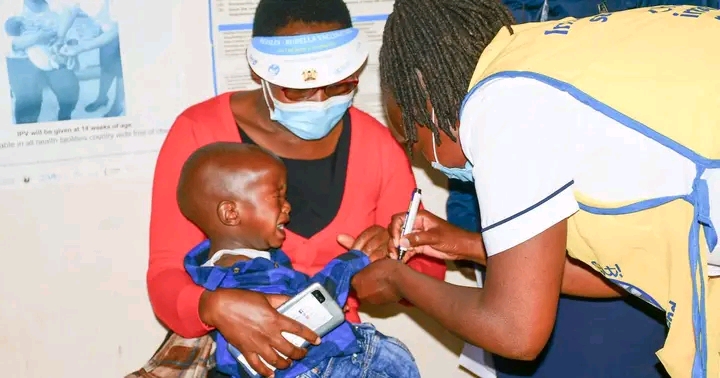

Nairobi, Kenya| Kenya has embarked on a nationwide vaccination campaign targeting measles-rubella (MR) and typhoid, a critical public health initiative aimed at safeguarding millions of children from preventable diseases.
Launched today in Thika, the campaign, spearheaded by the Ministry of Health, will run from July 5 to July 14, 2025, covering all 47 counties.
The program seeks to vaccinate 7.5 million children aged 9 months to 59 months against measles-rubella and 21 million children aged 9 months to 14 years against typhoid, marking one of the country’s most extensive immunization drives to date.
Addressing a Growing Public Health Threat
The campaign comes in response to a troubling rise in measles cases, with over 150 confirmed infections reported across 25 counties in 2025, according to the Ministry of Health.
Measles, a highly contagious viral disease, poses severe risks to young children, including complications such as pneumonia, blindness, and even death. Similarly, typhoid, a bacterial infection caused by Salmonella Typhi, remains a persistent threat, particularly in densely populated informal settlements where access to clean water and sanitation is limited.
The Ministry has identified these diseases as urgent public health priorities, prompting the rollout of this large-scale vaccination effort.
Kiambu County Immunization Coordinator Bernard Mwenga underscored the campaign’s significance during the launch event in Thika, stating, “This is not merely a vaccination drive. It is about securing Kenya’s future, one child at a time.”
Mwenga emphasized the proven safety and efficacy of the vaccines, urging parents to take advantage of this opportunity to protect their children from life-threatening illnesses.
Comprehensive Reach and Accessibility
To ensure no child is left behind, the Ministry of Health has adopted a multi-faceted approach to vaccine distribution. Vaccinations will be available at health facilities, schools, churches, mosques, and through mobile outreach teams deployed to remote and hard-to-reach areas.
This strategy aims to overcome logistical barriers and maximize coverage, particularly in underserved regions where access to healthcare services is limited.
The campaign targets two distinct groups: children aged 9 months to 59 months for the measles-rubella vaccine and those aged 9 months to 14 years for the Typhoid Conjugate Vaccine (TCV).
The TCV, a game-changer in typhoid prevention, offers up to five years of protection with a single dose, making it a highly effective tool in combating the disease. By integrating both vaccines into a single campaign, the Ministry aims to streamline efforts and achieve significant public health gains in a short period.
Why Measles-Rubella and Typhoid?
Measles and rubella are vaccine-preventable diseases that continue to pose significant risks in Kenya. Measles can spread rapidly in unvaccinated populations, with outbreaks often linked to low immunization rates in certain communities.
Rubella, while typically milder, can cause severe congenital defects if contracted during pregnancy. The combined measles-rubella vaccine is a proven intervention that has significantly reduced the global burden of these diseases.
Typhoid, on the other hand, is a waterborne disease prevalent in areas with poor sanitation and hygiene. In Kenya, informal settlements in urban areas like Nairobi and Mombasa are particularly vulnerable to typhoid outbreaks.
The introduction of the TCV in this campaign marks a significant step toward reducing the disease’s impact, offering long-term protection to children in high-risk areas.
A Call to Action for Parents and Communities
Health officials are calling on parents, guardians, and community leaders to actively participate in the campaign by ensuring children are vaccinated within the 10-day window.
The vaccines are provided free of charge, eliminating financial barriers to access. Community health workers and local leaders are also being mobilized to raise awareness and address vaccine hesitancy, which remains a challenge in some areas due to misinformation.
The Ministry of Health has assured the public that the vaccines have undergone rigorous safety testing and are endorsed by global health authorities, including the World Health Organization (WHO).
“These vaccines are safe, effective, and critical to protecting our children,” Mwenga reiterated. “We urge every parent to take their children to the nearest vaccination site and be part of this life-saving effort.”
A Step Toward a Healthier Future
The nationwide vaccination campaign represents a pivotal moment in Kenya’s ongoing efforts to strengthen its immunization programs and reduce the burden of preventable diseases.
By targeting millions of children across diverse settings, the initiative aligns with global health goals, including the WHO’s Immunization Agenda 2030, which seeks to ensure equitable access to vaccines worldwide.
As the campaign unfolds, health officials are optimistic about its potential to curb the spread of measles, rubella, and typhoid, paving the way for a healthier, more resilient generation. Parents are encouraged to visit local health facilities or contact community health workers to locate the nearest vaccination site.
For more information on the campaign, including vaccination schedules and locations, visit the Ministry of Health’s official website or contact your county health office. Together, Kenya is taking a bold step toward a future free from the threat of preventable diseases.
Share This Post