


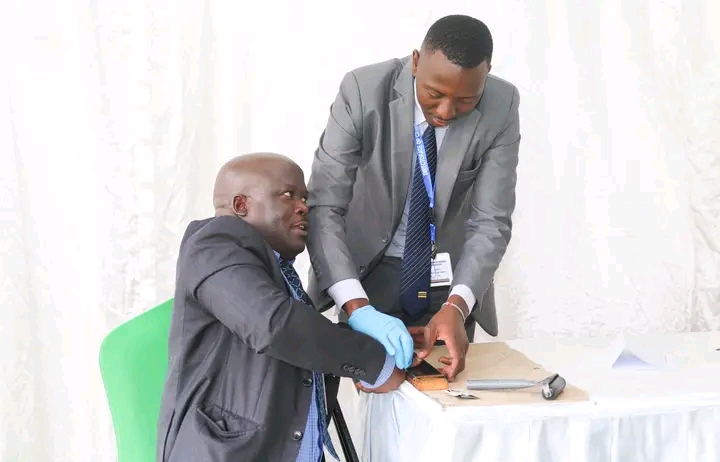



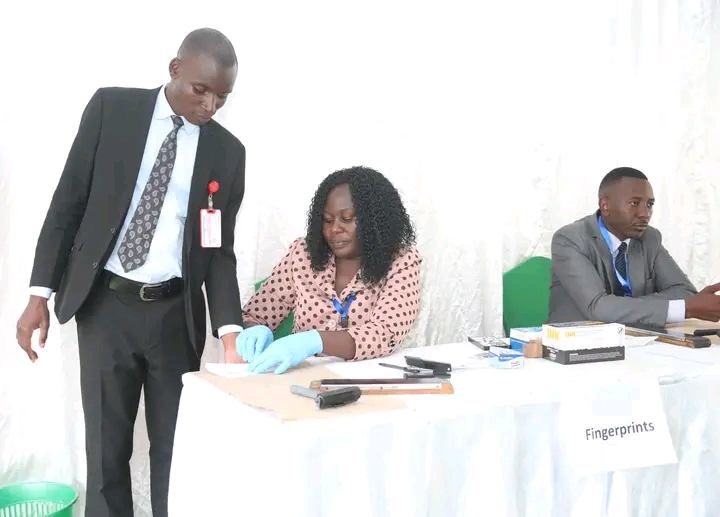


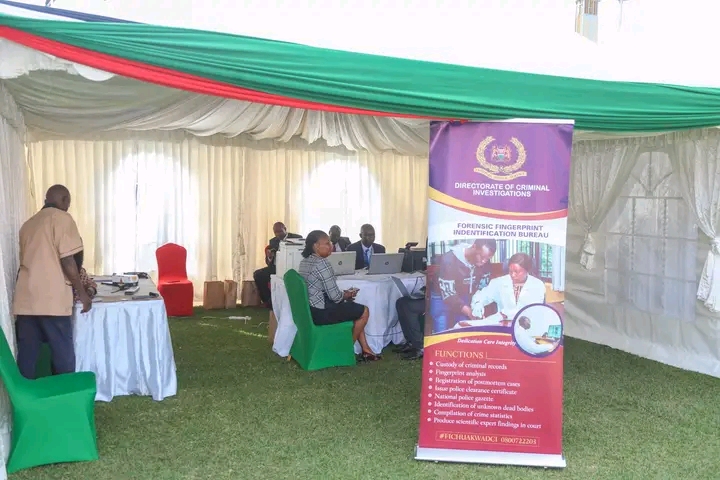
Nairobi, Kenya| The Directorate of Criminal Investigations’ (DCI) Forensic Fingerprint Identification Bureau (FFIB) took a significant step toward improving public service delivery by setting up a temporary camp at the Parliament grounds during the National Assembly’s 2025 Wellness Clinic.
The initiative, aimed at providing seamless access to essential services, allowed National Assembly staff to apply for Police Clearance Certificates (PCCs) directly on-site, with processing promised within a swift 24-hour timeframe.
The event, graced by the Speaker of the National Assembly, Hon. Moses Wetang’ula, underscored the government’s commitment to fostering inter-agency collaboration and enhancing workplace convenience for public servants.
The FFIB’s presence at the Wellness Clinic was a highlight, offering staff an opportunity to obtain critical documentation without the need to visit external DCI offices, thereby saving time and resources.
Streamlined Services for National Assembly Staff
The FFIB, a specialized unit within the DCI’s National Forensic Laboratory, set up a fully operational stand to facilitate the application process for PCCs, previously known as Certificates of Good Conduct.
These certificates are vital for various purposes, including employment, visa applications, and other legal requirements, as they confirm an individual’s criminal record status or lack thereof.
Mr. Samuel Njoroge, Clerk of the National Assembly, expressed heartfelt appreciation to the DCI and other participating government agencies for their proactive approach.
“This initiative demonstrates a remarkable commitment to public service,” Njoroge remarked. “By bringing these services directly to our staff, the DCI has not only saved us significant time and effort but also showcased the power of collaboration in improving efficiency.”
The on-site service camp allowed staff to submit their applications seamlessly, with the FFIB leveraging advanced fingerprinting technology to ensure accuracy and expedite processing.
The promise of a 24-hour turnaround time for PCC issuance further highlighted the bureau’s efficiency and dedication to modernizing service delivery.
The Role of the Forensic Fingerprint Identification Bureau
The FFIB plays a pivotal role in Kenya’s criminal justice system, operating under the DCI’s National Forensic Laboratory.
The bureau is tasked with a wide range of responsibilities, including:
- Processing Police Clearance Certificates: The FFIB handles the issuance of PCCs, ensuring individuals can obtain these documents swiftly for professional and legal purposes.
- Maintaining Criminal Records: The bureau maintains a comprehensive database of criminal records, enabling accurate tracking and verification of individuals’ histories.
- Fingerprint Analysis: Using state-of-the-art forensic technology, the FFIB conducts detailed fingerprint analysis to support criminal investigations and identification processes.
- Identification of Unknown Deceased Persons: The bureau assists in identifying unknown bodies through advanced fingerprint matching, providing closure to families and aiding law enforcement.
- Compiling Crime Statistics: The FFIB contributes to national security by analyzing crime data, which informs policy decisions and resource allocation.
By leveraging cutting-edge forensic tools and expertise, the FFIB ensures accuracy, reliability, and efficiency in its operations, making it an indispensable component of Kenya’s law enforcement framework.
A Broader Commitment to Public Service
The FFIB’s participation in the Wellness Clinic reflects a broader trend of government agencies adopting innovative approaches to bring services closer to the public.
The National Assembly’s 2025 Wellness Clinic, designed to promote the holistic well-being of its staff, provided an ideal platform for such initiatives.
Other government agencies also participated, offering a range of services, from health screenings to administrative support, further emphasizing the collaborative spirit of the event.
Speaker Moses Wetang’ula commended the DCI for its forward-thinking approach, noting that such initiatives strengthen public trust in government institutions.
“The presence of the FFIB here today is a testament to the DCI’s dedication to serving Kenyans efficiently and effectively,” he said.
Enhancing Accessibility and Efficiency
The decision to bring PCC services to the Parliament grounds aligns with the DCI’s ongoing efforts to modernize and decentralize its operations.
By setting up temporary camps at strategic locations, the FFIB ensures that essential services are accessible to a wider audience, reducing bureaucratic hurdles and wait times.
This move is particularly significant for public servants, who often face time constraints due to demanding schedules.
The 24-hour processing commitment is a notable improvement over traditional timelines, which could take days or weeks.
This efficiency is made possible by the FFIB’s integration of advanced biometric technology and streamlined workflows, which minimize delays while maintaining the highest standards of accuracy.
Looking Ahead
The success of the FFIB’s camp at the National Assembly Wellness Clinic sets a precedent for similar initiatives across other government institutions and public spaces.
By prioritizing accessibility, efficiency, and collaboration, the DCI is paving the way for a more responsive and citizen-centric public service framework.
As Kenya continues to embrace technological advancements in governance, initiatives like these highlight the potential for innovation to transform service delivery.
The FFIB’s efforts at the Wellness Clinic not only facilitated essential administrative processes but also reinforced the importance of inter-agency partnerships in achieving national development goals.
For more information on applying for a Police Clearance Certificate or accessing other DCI services, visit the official Directorate of Criminal Investigations website or contact your nearest DCI office.
Share This Post