

In a dramatic escalation of tensions in the Middle East, U.S. President Donald Trump announced on Saturday, June 21, 2025, that U.S. military forces, in coordination with Israel, conducted targeted strikes on three Iranian nuclear facilities.
Trump claimed the strike resulted in the “complete and total obliteration” of Iran’s key nuclear enrichment sites.
The strikes mark a significant shift in U.S. foreign policy, directly involving the United States in Israel’s ongoing campaign to dismantle Iran’s nuclear capabilities, despite Trump’s previous pledges to avoid Middle East conflicts.
The move has sparked intense debate domestically and raised fears of broader regional instability.
A “Spectacular Military Success”
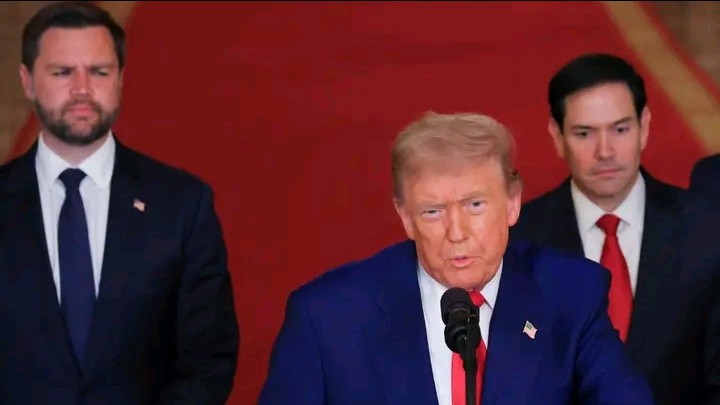
In a televised address to the nation on Saturday night, President Trump described the operation as a “spectacular military success,” asserting that the strikes had effectively neutralized Iran’s nuclear program.
“Tonight, I can report to the world that the strikes were a spectacular military success. Iran’s key nuclear enrichment facilities have been completely and totally obliterated,” Trump declared.
He thanked the U.S. military and invoked divine blessings, concluding with, “God bless the Middle East, God bless Israel, and God bless America.”
The operation followed a week of Israeli airstrikes aimed at degrading Iran’s air defenses, missile capabilities, and nuclear infrastructure.
A White House official confirmed that the U.S. provided Israel with advance notice of the strikes, marking a deepening of U.S.-Israel military coordination.
The decision to target Iran’s nuclear sites directly aligns with longstanding concerns about Iran’s potential to develop nuclear weapons, a prospect that both the U.S. and Israel have vowed to prevent.
Iran’s Response and Damage Assessment
Iranian state media, including Mehr News, downplayed the extent of the damage, reporting that only the entrance and exit tunnels of the heavily fortified Fordow nuclear facility were affected.
Iranian officials have not yet issued a comprehensive statement on the strikes, but the limited acknowledgment suggests an attempt to project resilience amid domestic and international scrutiny.
However, the strikes have heightened tensions across the region. Pro-Iranian militia groups in Iraq have reportedly mobilized, with Iraqi security forces deploying outside the U.S. Embassy in Baghdad at 3:00 a.m. local time on Sunday, June 22, 2025, due to fears of retaliatory attacks by these militias.
Additionally, a U.S. CH-47 Chinook helicopter was observed over Erbil, reportedly conducting evacuations, signaling heightened U.S. security concerns in the region.
Trump’s Ultimatum to Iran
President Trump issued a stark ultimatum to Iran, repeatedly urging the country to “make peace immediately” or face “far greater” consequences.
“Iran, the bully of the Middle East, must now make peace. If they do not, future attacks will be far greater and a lot easier,” he warned.
Trump reiterated his willingness to order additional strikes, stating he would “hit Iran again” if the country retaliated against U.S. or allied assets in the region.
U.S. Senator Tom Cotton echoed this sentiment, warning Iran against retaliatory actions and emphasizing the U.S.’s military readiness.
The rhetoric has raised concerns about a potential spiral of violence. Trump’s characterization of Iran as the “bully of the Middle East” and his threats of further military action underscore a hardline stance that contrasts with his earlier campaign promises to extricate the U.S. from Middle East conflicts.
Domestic Political Fallout
The strikes have ignited a firestorm of controversy in the U.S., with sharp divisions emerging among lawmakers.
Progressive Democrats, including Representative Alexandria Ocasio-Cortez (AOC) and Senator Elizabeth Warren, condemned the strikes as unconstitutional and unauthorized.
AOC announced plans to draft articles of impeachment, arguing that Trump’s actions violated Congress’s sole authority to declare war. “He will have to answer to her,” she stated, signaling a looming political battle.
Warren similarly criticized the strikes, calling them a “horrific war of choice” and urging the Senate to vote immediately to prevent further escalation.
“Only Congress can declare war,” she emphasized, highlighting the constitutional questions surrounding the president’s unilateral military action.
In contrast, some Republicans, including Senator John Fetterman, praised the operation.
Fetterman described the strikes as “the correct move,” citing Iran’s role as the “world’s leading sponsor of terrorism” and the necessity of preventing its acquisition of nuclear weapons.
“I’m grateful for and salute the finest military in the world,” he added, expressing support for the U.S. armed forces.
Regional and International Implications
The U.S. strikes represent a significant escalation in the shadow war between Iran and Israel, which has intensified in recent months.
Israel’s systematic targeting of Iran’s military and nuclear infrastructure over the past week laid the groundwork for the U.S. operation, raising questions about the extent of coordination between the two allies.
The strikes also come amid stalled diplomatic efforts to revive the 2015 Iran nuclear deal, formally known as the Joint Comprehensive Plan of Action (JCPOA), which aimed to curb Iran’s nuclear ambitions in exchange for sanctions relief.
The involvement of the U.S. risks further destabilizing an already volatile region. Iran’s proxies, including Hezbollah in Lebanon and militia groups in Iraq and Syria, may retaliate, potentially drawing the U.S. into a broader conflict.
The deployment of Iraqi security forces near the U.S. Embassy in Baghdad and reports of U.S. evacuations in Erbil underscore the immediate security challenges.
Internationally, the strikes are likely to strain U.S. relations with allies who favor diplomacy over military action.
The European Union, Russia, and China, all signatories to the JCPOA, have yet to respond formally, but their reactions will shape the geopolitical fallout.
Strategic and Legal Questions
The decision to strike Iran’s nuclear facilities raises complex strategic and legal questions.
While the U.S. and Israel argue that Iran’s nuclear program poses an existential threat, critics contend that military action could accelerate Iran’s pursuit of nuclear weapons rather than deter it.
The destruction of nuclear sites, if confirmed, may set back Iran’s program by years, but it could also harden Tehran’s resolve to rebuild and retaliate.
Legally, the strikes have reignited debates about presidential war powers. The War Powers Resolution of 1973 requires the president to notify Congress within 48 hours of committing armed forces to hostilities and to withdraw forces within 60 days unless Congress authorizes continued action.
Trump’s failure to seek congressional approval has fueled accusations of overreach, setting the stage for a constitutional showdown.
Looking Ahead
As the dust settles from the U.S. strikes, the Middle East stands at a crossroads. Iran’s next moves—whether diplomatic overtures or retaliatory actions—will shape the trajectory of the conflict.
The U.S. and Israel, meanwhile, face the challenge of balancing their hardline stance with the risks of a wider war.
Domestically, Trump’s decision has deepened political divisions, with impeachment threats and congressional debates looming.
For now, the world watches anxiously as the region teeters on the brink of further escalation.
President Trump’s call for peace, juxtaposed with his threats of greater military action, encapsulates the high-stakes gamble of this moment.
Whether his strategy will lead to de-escalation or a broader conflict remains uncertain.
Share This Post