
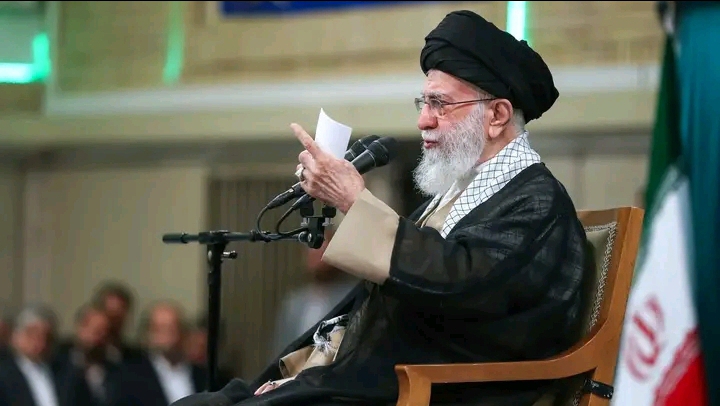

In a climate of heightened tension and fear of assassination, Iran’s Supreme Leader, Ayatollah Ali Khamenei, has reportedly entrusted his safety to a previously undisclosed elite bodyguard unit, according to a detailed report by The Telegraph.
This clandestine group, unknown even to senior officials within Iran’s Islamic Revolutionary Guard Corps (IRGC), underscores the unprecedented measures being taken to protect Khamenei as Israel, and now the United States, intensify military operations against Iran.
The emergence of this unit, coupled with Khamenei’s strategic moves to secure his legacy and Iran’s leadership structure, paints a picture of a nation grappling with internal vulnerabilities and external threats.
A Secretive Unit for Unprecedented Times
The Telegraph report reveals that Khamenei’s new security detail is composed of thoroughly vetted personnel, operating in secrecy to prevent infiltration.
“But his life is in danger, and there is a unit responsible for his protection that no one even knew existed to avoid any chance of infiltration,” an unnamed Iranian official told the outlet.
The official emphasized Khamenei’s resolve to remain in Iran, contrasting his stance with that of former Syrian President Bashar al-Assad, who fled amid conflict. “He is in Iran and is not going anywhere. He won’t flee like the coward Assad,” the official stated.
The existence of this covert unit highlights the acute security concerns surrounding Khamenei, whose whereabouts remain shrouded in mystery.
Speculation, as noted by The Telegraph, suggests he may reside beneath or near the IRGC’s media operations center in central Tehran.
To further evade tracking, Khamenei reportedly avoids electronic communication, relying instead on an aide to relay messages to Iranian commanders, according to The New York Times, which cited unnamed Iranian officials.
Iran’s Leadership Under Siege
The escalation of Israeli military actions, which began with a significant offensive on June 13, 2025, has decimated Iran’s military leadership.
The Times of Israel reported that an Israeli airstrike on Saturday killed Saeed Izadi, head of the Palestine Corps within the IRGC’s Quds Force.
The Israel Defense Forces (IDF) described Izadi as a key figure in Hamas’s October 7, 2023, attack, alleging he was one of the few who knew of the plan beforehand.
The rapid elimination of senior commanders, including a newly appointed head of Iran’s military killed just days after his promotion, has exposed significant vulnerabilities in Iran’s security apparatus.
Mahdi Mohammadi, a top adviser to Iran’s parliamentary speaker, General Mohammad Ghalibaf, acknowledged these failures in a leaked audio recording.
“It is clear that we had a massive security and intelligence breach; there is no denying this,” Mohammadi said. “Our senior commanders were all assassinated within one hour.”
This candid admission underscores the chaos within Iran’s leadership as it faces relentless Israeli strikes.
Strategic Moves to Secure Succession
In response to the ongoing crisis, Khamenei has taken proactive steps to ensure continuity in Iran’s leadership.
According to The New York Times, he has appointed replacements for military leaders killed in Israeli attacks and, in a rare move, selected three top Islamic clerics as potential successors to his role as Supreme Leader.
This decision marks a significant departure from tradition, as the position of Supreme Leader is typically decided by the Assembly of Experts after a leader’s death.
Khamenei’s preemptive naming of successors reflects the precariousness of his situation and the broader instability facing Iran’s regime.
The New York Post reported a source close to the White House commenting on these developments with a mix of derision and warning.
“If you need any more evidence that the ayatollah is shaking in his boots, look no further than him identifying his three stooges,” the unnamed source said.
A former Trump administration national security official added, “Like the new head of the Iranian military whom the Israelis killed last week only days after he was promoted, these guys are not long for this world.
Their new godly command should be to book a one-way ticket out of the country ASAP.” These remarks highlight the international perception of Iran’s leadership as increasingly vulnerable.
Broader Implications for Iran and the Region
The intensified military campaign against Iran, led primarily by Israel with apparent U.S. involvement, has far-reaching implications for the region.
Iran’s weakened military leadership and the exposure of its intelligence failures could embolden its adversaries while straining its alliances, particularly with groups like Hamas and Hezbollah.
Khamenei’s decision to fortify his personal security and plan for succession suggests a regime bracing for further escalation.
The secrecy surrounding Khamenei’s movements and the existence of his new bodyguard unit also reflect Iran’s broader strategy of opacity in the face of external threats.
By limiting electronic communication and relying on trusted intermediaries, Khamenei aims to minimize the risk of being targeted.
However, these measures also isolate him from direct control, potentially complicating Iran’s ability to respond cohesively to ongoing attacks.
What Next?
As Iran navigates one of the most perilous periods in its recent history, Ayatollah Ali Khamenei’s reliance on a secretive elite unit and his proactive steps to secure his legacy reveal a leader under siege.
The rapid elimination of Iran’s military commanders, coupled with intelligence breaches, has exposed the regime’s vulnerabilities, prompting extraordinary measures to protect its highest authority.
While Khamenei remains steadfast in his refusal to flee, the challenges facing Iran’s leadership are mounting, with implications that could reshape the geopolitical landscape of the Middle East.
Share This Post