
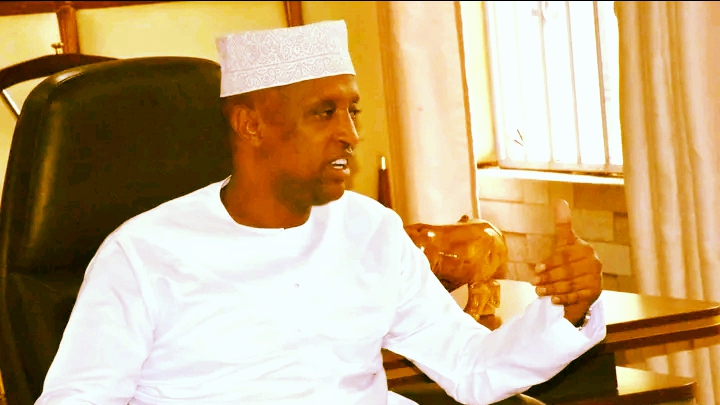

•An Unfolding Legacy of Transformative Leadership, 2.5 Years In
In a region often relegated to the periphery of national development discourse, Governor Abdi Ibrahim Guyo is quietly rewriting Isiolo County’s story—project by project, ward by ward.
Two and a half years into his first term, Guyo’s administration has not only met the moment—it is defining it.
Guided by a bold vision, strategic partnerships, and relentless execution, Governor Guyo is charting a path of inclusive growth that is fast earning him a place among Kenya’s most effective devolved leaders.
This analysis takes a comprehensive look at the substance and impact of Guyo’s developmental blueprint—one that speaks not just to delivery, but to durability, equity, and long-term transformation.
Reimagining Education: Laying Foundations for a Generation
Few initiatives capture Governor Guyo’s people-first philosophy better than the fortified porridge program, a landmark intervention reaching over 15,000 Early Childhood Development Education (ECDE) learners.
In a region where food insecurity often intersects with poor academic outcomes, this program is as much a nutritional lifeline as it is a strategic educational investment.
The program is not a headline—it is a habit, deeply embedded in the school day of every ECDE learner countywide.
Beyond meals, the Governor has overseen the construction of 25 modern classrooms and recruited 38 new ECDE teachers, easing overcrowding and addressing long-standing staff shortages.
This dual intervention—improving infrastructure and instruction—signals a deliberate strategy to anchor Isiolo’s future in skilled, educated youth. His vision resonates with national goals but roots itself in local realities.
Water Security: Turning a Lifeline into a Right
In the arid heartlands of northern Kenya, access to clean water is often the boundary between survival and despair. Under Guyo’s leadership, Isiolo has moved decisively to reclaim water security from the margins.
With 52 boreholes drilled and equipped, including 36 already operational, communities in remote areas like Merti-Lakole and Dadachabasa are now accessing reliable water for both household and agricultural use.
More telling is the county’s forward-looking budget increase—a 24% jump in water funding for FY 2024/25.
The Governor’s push to acquire a county-owned drilling rig represents a deeper shift: from reactive aid dependency to proactive self-sufficiency.
Meanwhile, the 10-kilometer Dadabacha pipeline, the planned 7-kilometer expansion in Wabera and Bula Pesa, and the rehabilitation of the Mwangaza Water Treatment Plant—all in collaboration with USAID-STAWI—point to a water infrastructure ecosystem that is not only expanding but also modernizing.
Healthcare Access, Reimagined
If there is one sector that underscores Governor Guyo’s grasp of devolved governance’s true intent, it is healthcare.
Under his stewardship, the Isiolo County Teaching and Referral Hospital (ICTRH) is undergoing a transformative upgrade, including the development of a state-of-the-art Accident and Emergency Centre funded by the World Bank.
This is more than a facility—it is a regional lifeline serving not just Isiolo but parts of Meru, Samburu, and Marsabit.
In rural Isiolo, the story continues. From the operationalization of dispensaries in Prakuruk and Lengurma, to the fully equipped maternity wings in Lengurma, and new health centers in Kiwanjani and Mwangaza, the Governor is decentralizing healthcare in both spirit and structure.
A standout milestone is the launch of an Eye Unit at Garbatulla Level 4 Hospital, which has already restored sight to over 200 residents through cataract surgery.
Land Justice and Economic Empowerment: Restoring Dignity Through Title Deeds
Land disputes have historically stifled development in Isiolo. Governor Guyo has tackled this legacy head-on by issuing 1,191 allotment letters across Isiolo Central, including long-contested settlements like Kulamawe, Kiwanjani, Tuluroba, and Kambi Garba.
In Bulapesa, 295 letters were distributed in a historic move, with the county absorbing KSh 2.4 million in premium fees to accelerate the process.
His collaboration with the National Land Commission and national agencies reflects a shrewd understanding of governance: development cannot take root on uncertain ground.
Equally transformative is the digitization of land records—a forward-looking solution to minimize fraud, resolve disputes, and usher in a culture of data-driven land management.
Infrastructure and Irrigation: Roads That Lead Somewhere
Governor Guyo recognizes that infrastructure is not just about roads—it’s about access, inclusion, and economic vitality.
Whether it’s the bitumen-standard upgrade of the Kachewa–Ole Jarole–Makaburini road in Bulapesa, or the murraming of 9.5 kilometers of Shambani–Alamach road in Burat, the County is knitting together previously isolated regions and improving mobility for trade, schooling, and health.
On the agricultural front, irrigation schemes in Gabaya, Tiyole, and the rehabilitation of Elsa Ntirim are turning arid plots into productive fields, directly tackling food insecurity and boosting climate resilience.
These are not one-off projects—they are systemic corrections in a county vulnerable to drought and volatile food supplies.
From Livestock to Industry: Powering Local Economies
Isiolo’s economic pulse has always beat with livestock. Governor Guyo is amplifying that heartbeat through value addition.
The operationalization of the Isiolo Export Abattoir and construction of a Class C slaughterhouse in Ngaremara are game-changers for herders, especially during drought seasons.
The abattoir’s daily processing capacity—1,000 goats, 200 cows, and 100 camels—means that Isiolo is no longer exporting just livestock, but finished products with better market value.
More ambitious still is the KSh 1.5 billion Aggregation and Industrial Park at the idle Isiolo Prison farm, built in partnership with the national government.
This project positions Isiolo as a future manufacturing and agro-processing hub for Northern Kenya—a visionary leap toward industrial decentralization.
A Governor of Inclusion and Security
Governor Guyo’s approach is holistic, reaching even the most vulnerable. Waiving park fees for persons with disabilities and women’s self-help groups speaks volumes about an administration that views inclusion as policy, not charity.
In a region bordering conflict-prone zones, his ongoing coordination with national and county security agencies to bolster security presence in hotspots is critical.
Development is only meaningful if it can be defended, and Guyo is ensuring Isiolo’s gains are not reversed by insecurity.
A Two-Term Legacy in Motion
Governor Abdi Guyo’s leadership is not defined by rhetoric but by results—tangible, trackable, and transformative. In just 30 months, his administration has delivered a blueprint that is as ambitious as it is achievable.
By embedding development within the framework of the CIDP 2023–2027 and aligning with Kenya Vision 2030, Guyo is future-proofing Isiolo’s growth.
Whether in the classrooms of Kinna, the dispensaries of Oldonyiro, or the abattoirs of Ngaremara, his leadership is leaving an unmistakable imprint.
The conversation among Isiolo residents is no longer whether Guyo deserves a second term—it is about what a second term could unlock. If the first half of his tenure is anything to go by, Isiolo is not just catching up—it is beginning to lead.
Isiolo’s Rising Star
Governor Abdi Ibrahim Guyo’s first 2.5 years in office have marked a turning point for Isiolo County.
His administration has achieved more than mere service delivery—it has rekindled belief in what devolution can achieve.
The challenges remain, but so does the Governor’s resolve. His track record is clear, his strategy coherent, and his impact profound.
If the trajectory holds, Isiolo under Guyo may well emerge as the north’s first true beacon of inclusive, resilient, and future-facing development.
Share This Post