
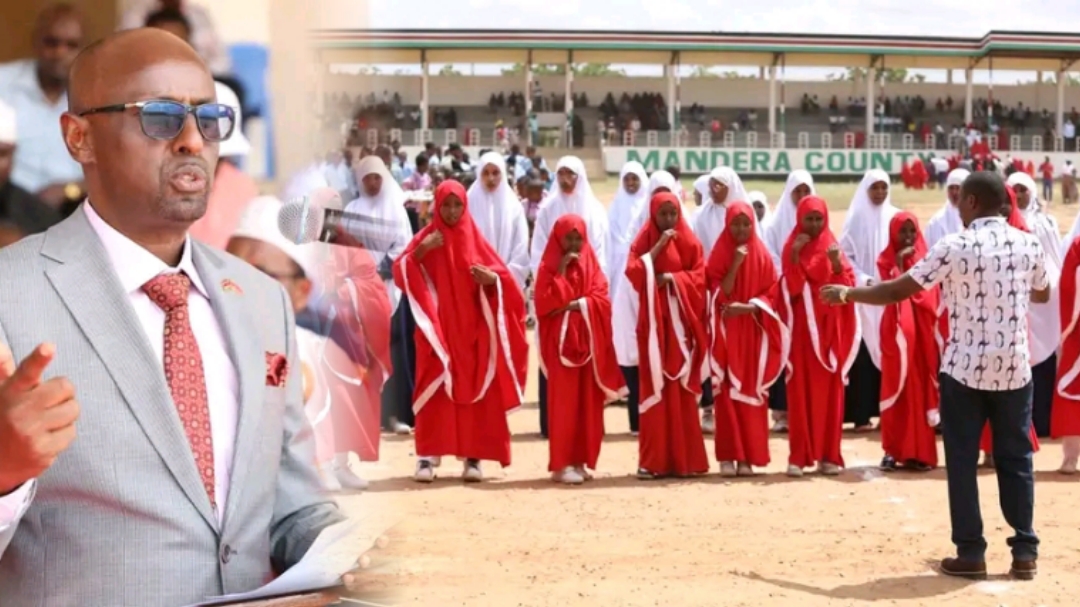

Mandera, Kenya| Mandera County marked Kenya’s 62nd Madaraka Day with a vibrant celebration led by Deputy Governor Dr. Ali Maalim Mohamud, E.B.S., who delivered an inspiring speech highlighting the county’s strides in water management, agriculture, healthcare, education, and peace-building.
The event, held under the national theme “Blue Economy and Maritime Affairs,” underscored Mandera’s contributions to sustainable development despite its arid and semi-arid challenges.
Honoring Kenya’s Self-Rule Legacy
In his address, Dr. Mohamud paid tribute to Kenya’s heroes and heroines who fought for self-governance, achieved on June 1, 1963.
Quoting the late President Mzee Jomo Kenyatta, he emphasized that self-rule brings not only freedom but also the responsibility to govern wisely.
“As we celebrate this historic milestone, let us build on the foundation laid by our forebears, striving for sustainable and self-reliant development,” he urged.
The deputy governor highlighted national priorities such as economic growth, education, and healthcare, which remain critical to Kenya’s progress.
He aligned Mandera’s efforts with these goals, showcasing initiatives that address local challenges while contributing to the national agenda.
Blue Economy in an Arid Context
While Kenya’s blue economy is often associated with coastal and lake regions, Dr. Mohamud redefined its relevance for Mandera, an arid county with limited permanent water bodies. “Our contribution to the blue economy lies in seasonal rivers, dams, water pans, and boreholes,” he noted.
These resources support climate-smart agriculture, livestock productivity, and human consumption, addressing chronic water shortages.
During recent droughts, Mandera deployed 86 water bowsers, delivering 80 million liters of water to 623 centers, benefiting 477,796 people across 80,000 households.
To ensure long-term water security, the county launched the Takaba Water Supply Master Plan, a 25-year project targeting 42,000 beneficiaries.
Key components include drilling new boreholes, expanding earth pans to a 400,000m³ capacity, and establishing water treatment plants and distribution networks.
Water access has improved from 54% to 56% over the past year, driven by initiatives such as:
- Rehabilitation of 30 earth pans.
- Extension of 350 kilometers of water pipelines, serving 15,000 additional households.
- Equipping 25 rural water projects, with 200 schemes now covering 60% of the population.
- Construction of 60 underground storage tanks and 25 water pans for rainwater harvesting.
Advanced groundwater exploration equipment facilitated 80 hydrological surveys, leading to the successful drilling of 17 boreholes, including Eres Kore, Sukella Ulo, and Kob Adadi.
Agricultural Diversification and Resilience
Recognizing the vulnerability of Mandera’s pastoralist communities to cyclic droughts, the county is promoting agricultural diversification.
Eighteen irrigation and flood control projects were implemented across sub-counties, including:
- Burabor Farms Irrigation Pipeline and Neboi Farms Flood Control Structures in Mandera East.
- Desilting of water pans and irrigation pump-sets in Banissa.
- Solarization of Kalicha farms and irrigation canal access in Mandera North.
- Flood control structures in Aresa and Hareri (Arabia).
These efforts expanded irrigated land by 4.3%, while 1,187 farmers received training in climate-smart agriculture, pest management, and post-harvest handling.
Ongoing projects, such as the Yabicho irrigation infrastructure and Shantoley gabion wall, aim to further boost productivity.
Livestock: The Economic Backbone
As a predominantly pastoralist region, Mandera prioritizes livestock development. The operationalization of Takaba Livestock Market and the construction of Shimpir Fatuma Market have improved market access.
To cushion pastoralists against drought losses, 7,089 were enrolled in a livestock insurance program, each receiving a KES 6,000 bonus.
Livestock health initiatives included vaccinating 563,112 shoats against Peste des Petits Ruminants (PPR), 4,988 camels against Rift Valley Fever (RVF), and 10,996 cattle against Lumpy Skin Disease (LSD). Deworming covered 552,247 animals, and 5,864 received treatment.
Capacity-building trained 26 technical staff in participatory epidemiology and 60 community disease reporters in surveillance.
To diversify livelihoods, the county distributed 540 modern beehives, supporting honey production as an alternative income source.
Healthcare Transformation
Mandera’s healthcare sector has seen significant advancements. The upgrade of Mandera County Referral Hospital to a Level 5 Teaching and Referral Hospital (MCTRH) marks a milestone.
Banisa and Lafey theaters now offer emergency surgical and obstetric services, reducing referral burdens. All six Level 4 hospitals are being expanded and equipped for specialized care.
Medical supply funding increased from KES 322.7 million to KES 365 million, boosting supplies by 13% to 449 metric tons.
Twenty-seven health facilities were rehabilitated, and 12 new ones operationalized, with 113 facilities gazetted for accreditation.
The recruitment of 60 healthcare workers, including 12 medical officers, and training of 200 personnel in maternal and neonatal care have strengthened service delivery.
Three new ambulances enhance emergency response, while maternal health metrics improved: fourth antenatal care visits rose by 24% (from 13,314 in 2022 to 16,568 in 2024), and skilled deliveries increased by 22% (from 21,400 to 26,165).
Community health was bolstered by registering 212 new Community Health Units and training 2,120 Community Health Promoters, with 1,268 equipped for digital health monitoring.
Over 104,040 residents are registered under the Social Health Authority (SHA), with seamless claims processing in public facilities.
The county-funded Kenya Medical Training College (KMTC) in Mandera now offers nursing and clinical medicine programs, ensuring a steady supply of healthcare professionals.
Education for All
Through the Elimu Kwa Wote initiative, Mandera disbursed KES 1.27 billion in bursaries over three years, supporting 34,372 secondary and 5,697 tertiary students.
Early Childhood Development Education (ECDE) enrollment grew from 23,499 in 2021 to 35,238 in 2024-2025, with 367 ECDE centers and 450 new teachers. Transition rates from ECDE to primary schools reached 92% in 2024, up from 80% in 2023.
To address teacher shortages, the county funds 50% of college fees for 1,102 teacher trainees in 2025, up from 696 in 2024.
Technical and Vocational Education and Training (TVET) enrollment rose by 32% (from 465 in 2022 to 616 in 2024-2025), with graduates receiving start-up kits.
Environmental Conservation
Mandera’s afforestation efforts earned it the 2024 World Green City award. In 2023, 30,420 trees were planted, and 16,000 seedlings were distributed during the 2025 long rains.
The Elwak Baraza Park Ecosystem Restoration Project and similar initiatives at Lafey schools promote sustainability.
The Neboi Ward Riparian Ecosystem Restoration Project uses bamboo to stabilize River Daua’s banks, reducing erosion and flooding.
Social Protection and Inclusion
To combat food insecurity, Mandera provided food and non-food items to 240,000 households between November 2022 and February 2025. The Mandera County Social Protection Bill 2024 will formalize support for vulnerable groups.
Mobility aids were distributed to persons with disabilities, and 148 housing units are under construction for low-income families.
The county is intensifying efforts against Female Genital Mutilation (FGM) and Gender-Based Violence (GBV) through community education and collaboration with stakeholders.
Women entrepreneurs in Arabia Sub-County received income-generating equipment to foster economic independence.
Youth Empowerment and Trade
The Governor MAK Super Cup, launched in June 2024, engaged 246 football teams across 30 wards, promoting youth cohesion.
New sports infrastructure includes a basketball court at Mandera Stadium and renovations at Geneva Sports Ground. Three sub-county libraries and a planned Talent Academy will further youth development.
Mandera’s strategic border location enhances cross-border trade. The El Danaba Market and ongoing Banisa Market expansion have increased SMEs from 7,200 to 8,500.
Support for 20 cooperatives and 55 SMEs, alongside the launch of Mandera United Women Credit and Cooperative Society with 800 members, bolsters economic growth.
Land and Peace-Building
The Land Information Management System (LIMS) has digitized 12,728 land records and processed 9,000 title deeds, reducing disputes and boosting revenue.
The Mandera County Draft Peace-building and Conflict Management Policy and Bill 2024 will formalize conflict resolution.
The Maslaha Centre’s Alternative Justice System resolves disputes efficiently, while 174 monthly outreach programs promote tolerance.
Cross-border peace meetings with Ethiopia and Somalia, supported by partners like Inter-peace and Women for Peace, enhance regional stability.
Awareness sessions in Mandera South target vulnerable groups to counter violent extremism.
A Call for Continued Collaboration
Dr. Mohamud expressed gratitude to partners and NGOs, reaffirming Mandera’s commitment to inclusive service delivery.
“Together, we will create a safe, prosperous, and sustainable environment for all residents,” he concluded.
As Mandera celebrates its achievements, the county remains focused on building a resilient future, aligning local efforts with Kenya’s vision for sustainable development.
Share This Post